Search by brand

Login
To More Inquiry
Home | CAR | NEWS | WHAT IS RPM IN A CAR
What is RPM in a Car? Full Form, Meaning, and Everything Explained
Updated at :
Quick Answer: RPM stands for Revolutions per minute. It is the number of times a car's engine crank shaft turns a full circle in a minute. The engine speed display on the dashboard of your car shows the reading, called a Tachometer. The typical normal idle RPM in a car ranges from 600-1000, and for regular driving the typical RPM is from 1500-3000.
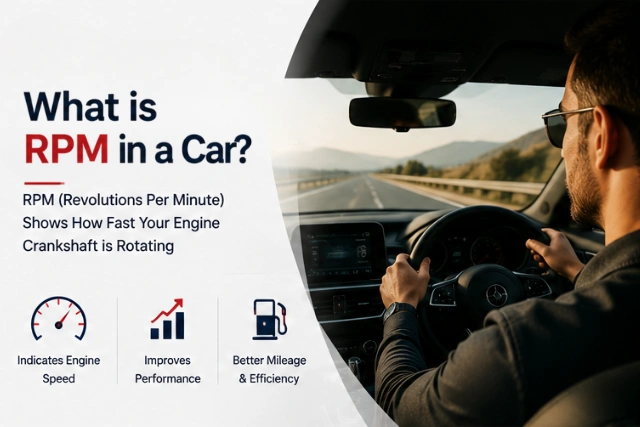
RPM stands for Revolutions Per Minute in cars. This refers to the rate at which the car’s engine crankshaft turns, i.e. How many revolutions are made in a minute. It is basically a unit of speed of your car’s engine.
We can see the RPM gauge in our cars moving up when we increase the speed, and moving down as we reduce it. If you’ve been paying attention, you would have surely observed this. However, learning what is RPM in a car becomes very important because it plays a crucial role in the performance of a car. It helps the car to get optimum fuel efficiency, it tells the driver when to change the gears and also affects the driving experience and performance.
The proper RPM in an Indian car can lead to increased mileage, reduce wear and tear of the engine, make it much easier to drive in traffic, and also at higher speeds.
Whether it is because you are learning to drive or you simply want to know what makes your engine sound so loud when you overtake, we have explained all the terms you require in this detailed guide!
What Is the Full Form of RPM in a Car?
- It stands for 'Revolutions per minute'. The definition of this specific abbreviation means 'the speed at which an engine's crankshaft rotates one complete rotation each minute'.
- As you can imagine, the crankshaft is the one internal rotating component inside your engine which actually converts the up-and-down motion of your pistons into rotational motion which spins your wheels around.
- Thus if your tachometer is showing 2, it actually means 2000 revolutions per minute and your crankshaft is spinning 2000 times a minute; a 5000 display on the dial means it's spinning 5000 times a minute.
- Thus the full form of RPM in a car is effectively telling you just that.
So simply speaking when you press down on your accelerator, accelerate to overtake another vehicle on the road or when climbing a steep incline and your engine 'sounds like it's working harder' what actually happens is that your engine's crankshaft has increased speed-it's similar to when you jog and your heart-rate increases; your engine is your car's heart!
What Is the RPM Meter in a Car?
The RPM meter in a car is officially called a tachometer. It's the gauge on your instrument cluster that displays engine RPM , usually positioned right next to the speedometer.
Here's how to read it:
- The tachometer dial shows numbers 1 through 8 (sometimes up to 9 or 10)
- Each number represents 1,000 RPM — so "3" = 3,000 RPM
- The red zone at the far end is called the red line — the maximum safe RPM for your engine
- Going past the red line risks serious engine damage
What does the tachometer look like in action?
What is a Normal RPM Range in a Car?
This is one of the most practical things to know as a driver. The idle rotation ranges between 600 RPM and 1,000 RPM, while the normal RPM range for cars on highways is generally between 1,500 RPM and 2,000 RPM.
Here's a full breakdown:
Normal RPM at Idle
The typical idle RPM range for most petrol-powered cars is between 600 and 1,000 revolutions per minute when the engine is warm and in park or neutral.
- Cold start (just turned on): 1,000–1,500 RPM — this is normal. The engine needs to warm up.
- Warm idle (engine fully warmed): 700–900 RPM — the sweet spot for most Indian cars
Normal RPM While Driving
Even though car and truck engines are different from one manufacturer to another, they all typically have the same normal operating range of RPM, which is 1,500–3,000 RPM under normal driving conditions.
RPM Ranges by Driving Situation
What is RPM in a Car Engine – How Does It Work?
Let's understand what's happening physically inside the engine when engine RPM changes.
Your car engine runs on a cycle: intake, compression, combustion, exhaust — repeated thousands of times per minute in each cylinder. Each time the piston completes this cycle, it pushes down on the crankshaft, making it rotate.
- When you press the accelerator pedal, the throttle opens wider, more air and fuel enter the cylinder, more combustion happens, and the crankshaft spins faster → RPM increases
- When you ease off the pedal, less fuel enters, combustion slows, the crankshaft spins slower → RPM decreases
- In neutral gear or at a red light, the engine idles and keeps itself running at the minimum stable speed — around 750 RPM for most Indian cars
The engine speed (RPM) and the actual car speed (km/h shown on the speedometer) are linked through your gearbox. This is why the same car speed can show different RPMs depending on which gear you're in — which brings us to the next important topic.
RPM and Gear Shifting - The Connection You Need to Understand
This is where RPM becomes really practical for everyday driving, especially in a manual transmission car.
In a Manual Transmission Car
In a manual transmission, you control gear changes yourself. RPM is your primary guide for when to shift gears:
- Shift up when RPM reaches around 2,500–3,000 RPM → keeps engine efficient
- Shift down before RPM drops below 1,500 RPM → prevents engine lugging
- Never let RPM climb into the red line for sustained periods → engine damage risk
Why does this matter? Because changing the gear early on rather than waiting for the roaring engine sound leads to better fuel economy. Similarly, changing to lower gears quickly while reducing vehicle speed achieves better fuel efficiency.
In an Automatic Transmission Car
In a car with an automatic transmission, the gearbox selects all gears on its own through use of the car's various sensors. It is constantly using the readings of how fast the car is moving and how much engine RPM is producing to know when it's time to shift.
With an automatic transmission the car will shift from lower gears to higher gears as you continue to accelerate aggressively. If you are easy on the accelerator pedal, then the automatic car will continue to run in lower gears. This is to achieve best performance from the car as well as gain better fuel economy.
Even in a car with an automatic, by monitoring the tachometer you can learn when the car is running efficiently and when you are "overworking" the engine.
What is RPM in a Bike - Is It the Same?
Yes , what is RPM in a bike has exactly the same answer. RPM in a bike also stands for Revolutions Per Minute and measures how fast the engine's crankshaft spins.
The difference is in the numbers. Bikes typically run at much higher RPM than cars:
- Most commuter bikes (Hero Splendor, Honda Activa) idle at 1,200–1,500 RPM
- Sports bikes (KTM Duke, Bajaj Pulsar RS200) can rev to 10,000–12,000 RPM
- A diesel engine, by comparison, might have a similar idle speed, but will be at the upper limit of its rev-range by about 4,000 RPM — significantly lower than petrol engines
What is BHP and RPM in a Car? Understanding the Relationship
When you read a car spec sheet, you'll often see something like: "100 BHP @ 6,000 RPM" , and many buyers ignore the second part. Don't.
BHP (Brake Horsepower) is the measure of an engine's power output. But here's the key: that power is only available at a specific RPM range.
- "100 BHP @ 6,000 RPM" means the engine produces its maximum 100 BHP when spinning at 6,000 RPM
- At lower RPM, the engine produces less than its rated power
- You need to rev the engine to that RPM band to unlock the full performance
BHP vs RPM - What the Numbers Mean:
What is RPM and Torque in a Car?
RPM and torque are the two pillars of engine performance, and they behave differently:
- Torque is the pulling/twisting force the engine produces — it's what helps you pull heavy loads, climb hills, and accelerate from standstill
- RPM is the speed at which the engine is spinning — higher RPM typically means higher power output
The relationship:
Power (BHP) = (Torque × RPM) ÷ 5,252
This formula explains why diesel engines (which produce high torque at low RPM) feel effortless in city traffic and on highways — they don't need high engine RPM to pull strongly. Petrol engines build power at higher RPM and feel more spirited when revved up.
What Happens When RPM is Too High or Too Low?
When RPM Is Too High (For Too Long)
- Increased fuel consumption - engine burns more fuel at high RPM
- More engine wear - components experience greater stress at high engine speed
- Overheating - risk increases significantly
- If you cross the red line, you risk catastrophic engine damage — broken pistons, blown gaskets, damaged valves
- Rev limiters in modern cars are designed to electronically cut fuel injection before you can damage the engine — this is why you hear a stuttering sound when you hit the RPM ceiling
What are rev limiters? Rev limiters are safety mechanisms built into modern ECUs that prevent the engine from spinning beyond its maximum safe RPM. They automatically cut fuel to protect the engine.
When RPM Is Too Low (Engine Lugging)
- Engine struggles and feels sluggish
- Vibration and shuddering — especially in manual transmission cars
- Increased risk of engine stalling
- Poor acceleration response
- Long-term engine stress from running below the optimal combustion range
What Causes Abnormal RPM Fluctuation?
If your engine RPM is jumping up and down on its own — especially at idle — here are the common causes:
What is RPM Fluctuation, and How to Fix it?
RPM fluctuation is a condition when the RPM of your vehicle goes up and down frequently for no apparent reason. This problem may occur due to the following reasons.
Bad Spark Plugs: Spark plugs fail as they wear over time and struggle to ignite the air fuel mixture. Hence RPM will fluctuate up and down a lot to accommodate it.
Vacuum Leakage: When the vacuum line gets faulty it causes vacuum to drop at the engine and affects engine performance leading to fluctuating RPM.
Carburettor Problems: A dirty and blocked carburettor may supply less fuel to the engine, hence leading to fluctuating engine performance.
Faulty throttle pedal sensor: problems in throttle pedal sensor will cause the RPM to fluctuate up and down when you try to accelerate the car.
Faulty Fuel Injectors: clogged or dirty fuel injectors can cause jumpy acceleration, due to which you might find it difficult to maintain the speed of your car and hence the engine RPM is affected.
Transmission fluid leakage: if there is a leak in the transmission fluid, the band in the gearbox becomes slippery. Because the car finds it hard to achieve higher speed, the engine speeds up the RPMs to make it possible.
Blocked air filter: An uneven and erratic engine performance can occur if the air filter becomes blocked. If the air supply to the vehicle engine becomes insufficient the vehicle RPM will drop or rise unexpectedly.
Faulty idle air control valve: If the idle air control valve has a defect in it then the RPM will rise and fall at regular intervals, even without acceleration.
The causes of most of these problems listed above are not overly complicated and should be fixed with a modest budget. If neglected, RPM fluctuation can develop into serious vehicle complications.
Below are the steps that you need to undertake to resolve the issue of engine RPM fluctuation.
Step 1: Check that your engine has been correctly tuned.
Step 2: check for any leaks in the air intake system.
Step 3: Make sure your throttle body is not blocked or dirty.
Step 4: Clean or replace any fouled or damaged spark plugs.
Step 5: Make sure there are no leaks in your engine vacuum line.
Step 6: replace the clogged/dirty fuel filter.
Step 7: pour in a fuel stabiliser to your fuel tank if you intend on parking your car for an extended period as it will protect your car's fuel system against corrosion and clogging.
Step 8: Check your ignition system to make sure that it works fine.
Step 9: Get the engine checked for low compression as well.
You can conduct an initial inspection independently if you have enough knowledge of the parts. However, taking the vehicle to a qualified professional for a thorough and accurate diagnosis is always better.
RPM and Fuel Economy - How Driving at the Right RPM Saves Money
This is something most Indian drivers don't pay enough attention to — but it directly affects how much you spend at the petrol pump.
RPM is critical for managing an engine's performance, fuel economy, and the transmission's health.
Here's the practical truth:
- Lower RPM = better fuel economy - the engine is working less hard
- Staying between 1,500–2,500 RPM on city roads is the most fuel-efficient range for most Indian cars
- On highways, most modern cars cruise efficiently at 1,500–2,000 RPM in the highest gear
- High RPM driving increases fuel consumption dramatically — a car at 5,000 RPM burns significantly more fuel than the same car at 2,000 RPM doing the same job
Practical fuel-saving RPM tips:
- Shift to a higher gear earlier in a manual car — don't wait for high RPM to shift up
- On highways, engage the highest gear as early as road speed allows
- Avoid aggressive acceleration — gradual throttle keeps RPM in the efficient band
- In city traffic, shift down early enough to avoid lugging the engine below 1,200 RPM
- Don't rev the engine unnecessarily at red lights or while warming up — modern fuel-injected engines don't need it
RPM Full Form in Different Contexts (Car, Bike, Motor, Fan, Computer)
Since RPM is used across many fields, here's a quick reference:
The concept is identical across all these applications — it always measures rotational speed in terms of complete rotations per minute.
Ideal RPM for Car - Quick Reference by Car Type
The Bottom Line: Why RPM Actually Matters for You
Understanding what is RPM in a car isn't just trivia — it's practical knowledge that makes you a better, more economical driver.
- Watch your RPM meter to know when to shift gears in a manual car
- Keep engine RPM between 1,500–2,500 for the best blend of performance and fuel economy
- Never sustain RPM in the red line — rev limiters protect you, but pushing them repeatedly causes wear
- If your engine RPM is fluctuating without reason, get it checked before it becomes a bigger problem
Every time that needle moves on your tachometer, your engine is talking to you. Now you can actually listen.
Want to check the RPM specs, BHP, and torque of any car before buying? Explore Full Car Specifications on VahanKhoj.
Compare engine specs, RPM ratings, fuel efficiency, and complete features of every car sold in India - in one place.
Frequently Asked Questions About RPM in a Car
What is the full form of RPM in a car?
The full form of RPM in a car is Revolutions Per Minute. It measures how many times the engine crankshaft completes one full rotation every minute and is displayed on the tachometer on your dashboard.
What is a good RPM for a car while driving?
For most Indian cars, the ideal RPM while driving is between 1,500 and 2,500 RPM in city traffic and 1,500–2,000 RPM on highways. Keeping your engine RPM in this range balances performance, fuel economy, and engine health.
What is the meaning of RPM in a car at idle?
At idle (engine running, car not moving), a normal car should sit between 600–1,000 RPM. A cold engine may briefly idle at 1,000–1,500 RPM for a few minutes while warming up — this is completely normal.
What is RPM and how does it affect fuel consumption?
RPM directly affects fuel consumption. Higher RPM means the engine is burning more fuel per minute. Driving at lower, efficient RPM ranges (1,500–2,500 in city) and shifting to higher gears earlier in manual cars are the two most effective ways to improve fuel economy.
What is BHP and RPM in cars?
BHP (Brake Horsepower) is the maximum power output of an engine. RPM is the engine speed at which that peak power is produced. A spec reading of "100 BHP @ 6,000 RPM" means the engine makes 100 BHP only when spinning at 6,000 RPM. Higher RPM at peak power = more sporty character.
What is RPM and torque in a car?
Torque is the pulling force the engine generates; RPM is how fast it's spinning. Together they determine power output: Power = (Torque × RPM) ÷ 5,252. Diesel engines produce peak torque at low RPM (1,500–2,500), making them efficient and strong for daily use. Petrol engines build power at higher RPM.
What are rev limiters in a car?
Rev limiters are electronic safety systems built into the ECU that cut fuel injection before the engine exceeds its maximum safe RPM. They prevent engine damage when RPM climbs into the red line zone. You'll experience them as a stuttering or bouncing sensation when you hit the RPM ceiling.
Why does my car's RPM fluctuate at idle?
RPM fluctuating at idle usually points to a dirty throttle body, faulty idle air control (IAC) valve, vacuum leak, or fuel delivery issue. If your engine RPM is bouncing up and down at idle, get it checked by a mechanic — it typically doesn't resolve on its own.
What is the difference between RPM in petrol and diesel engines?
Petrol engines produce peak power at high RPM (5,500–7,000) and feel more exciting when revved. Diesel engines produce peak torque at much lower RPM (1,500–2,500 RPM), making them quieter, more fuel-efficient, and better for long-distance highway driving without high engine stress.
What is the 'red line' on a tachometer?
The red line indicates the maximum safe RPM limit for an engine. Exceeding this limit can cause severe engine damage. Modern vehicles often have rev limiters to prevent surpassing this threshold.
Written by the VahanKhoj Team - India's trusted car research platform vahankhoj.com | Your one-stop guide for everything car-related in India.
Reviewed by Automotive Research Team
This article was reviewed using vehicle manufacturer resources, owner manuals, automotive engineering references, and publicly available information related to RPM, engine performance, fuel efficiency, and transmission systems.