Search by brand

Login
To More Inquiry
Home | CAR | NEWS | WHAT IS ESP IN A CAR
What is ESP in a Car? Full Form, How it Works & Why it Matters
Updated at :
Quick Answer: What is ESP in a car?
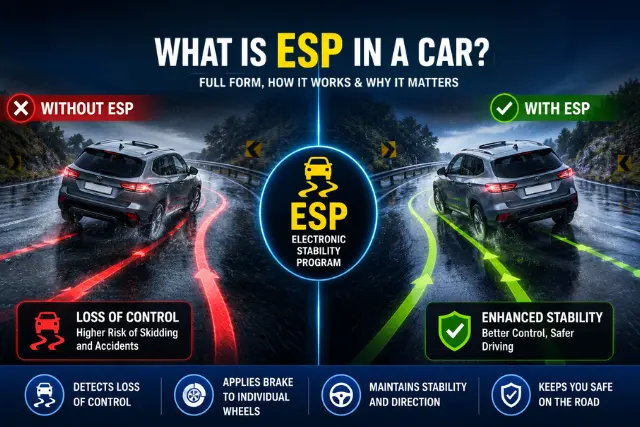
ESP stands for Electronic Stability Program(also Electronic Stability Control / ESC). It is an active safety system which will automatically sense when your car begins to skid or lose its grip and will brake the wheels it deems to be moving too fast individually to correct the car. It relies upon and works with your ABS and TCS systems.
Picture this: you're driving on a rain-soaked road, you steer to avoid something, and the back of the car starts sliding out. In a car without safety tech, that's where accidents happen. In a car with ESP, that sliding movement is detected and corrected in milliseconds — before you've even had a chance to react.
What is ESP in a car? It's one of the most important active safety features ever developed, and understanding how it works makes you a smarter, safer driver — and a more informed car buyer.
What is ESP in a Car? - The Simple Explanation
ESP stands for Electronic Stability Program. It's also very commonly known as Electronic Stability Control or ESC, since most manufacturers refer to the system as the ESC but use different names.
ESP (also known as ESC) stands for Electronic Stability Programme, and it's one of the most important safety features on your car. The electronic stability program (ESP) supports the driver in nearly all critical driving situations. It comprises the functions of the anti-lock braking system (ABS) and the traction control system, but can do considerably more. It detects vehicle skidding movements, and actively counteracts them.
To put it in simple terms: ESP is an invisible 'buddy' to your car. It "looks" at whatever the car is doing at every tiny instant of time and compares that against whatever you're attempting to do at the wheel, and makes up the difference where it's risky, and does it automatically at speeds nobody can compete with.
ESP Full Form in Car — And What Different Brands Call It
The ESP full form in cars is Electronic Stability Program. However, different car manufacturers have trademarked their own names for the same technology:
Different labels, same purpose — to help keep your vehicle stable and under control.
So when someone says their car has ESP, ESC, or DSC — they mean the same fundamental electronic stability program. The ESP full form in cars may vary by manufacturer, but the function is identical.
How Does ESP Work in a Car?
This is where it gets interesting. The ESP control unit compares the actual movement of the vehicle with the desired direction of travel hundreds of times per second.
Here's how the full ESP system operates step by step:
Step 1 - Sensors Read Everything in Real Time
ESP system functions using the data inputs from many sensors, which are continually supplying information to the control unit:
- Wheel speed sensors-measures the rotational speed of each individual wheel
- Steering angle sensor-measures the direction the driver is turning the steering wheel in intended direction
- Yaw rate sensors-measure the angular rate of the car about its vertical axis ( are you spinning?)
- Lateral acceleration sensor-measures the sideward acceleration( is the car sliding sideways?)
A yaw sensor located in the centre of the car detects side-to-side motion of the car. This helps the computer know which wheels have more grip and transfer more or less power or brake pressure to a wheel to have maximum traction at all times.
Step 2 — The ECU Detects a Problem
ESP system operates by receiving input from sensors, which can detect a vehicle's speed, the angle of its steering wheel and its yaw rate. If the system registers a vehicle is skidding by oversteering or understeering it then applies a brake to one of its wheels to regain the stability and avoid skidding.
Step 3 — ESP Intervenes Automatically
If the ESP system senses a skid or wheel slide, it reacts in two ways:
- It uses the brakes on individual wheels rather than applying all four.
- Reduces engine power — in some cases, the ESP system may also reduce engine power if excessive acceleration is detected, which can help prevent further loss of control
This whole process happens in milliseconds — typically faster than the human eye can blink.
ESP, ABS, and TCS - What's the Difference?
A lot of people confuse these three systems. They're related but each does a different job:
ESP is a platform where all sub-systems come together: ABS prevents the wheels from locking up when the driver brakes heavily; TCS/ASR stops the wheels spinning during acceleration, and EBD regulates brake distribution across the axles. With Brake Assist, the brakes are activated with more force in case of emergency stops.
Consider the following: ABS brakes for you during braking, TCS accelerates for you during acceleration, and ESP works for you when cornering or swerving – the time when most major accidents occur.
What Does the ESP Warning Light Mean in a Car?
The ESP warning light on your dashboard looks like a car with two skid marks underneath, sometimes with the letters "ESP" or "ESC" next to it.
There are two different scenarios:
1. ESP Warning Light Flashing (Briefly)
This is completely normal and good. A briefly flashing ESP warning light means the system just activated and saved you from a skid. It's doing exactly what it's supposed to do.
2. ESP Warning Light Stays On Permanently
If the ESP warning light stays on continuously after starting the car, that means there's a fault in the ESP system. Common causes include:
- Faulty wheel speed sensors
- Steering angle sensor fault
- Low battery voltage affecting the control unit
- Recent wheel alignment change not calibrated to the system
- Damaged yaw rate sensors
A permanent ESP warning light means your stability system is disabled. The car will still drive, but you've lost this safety net — get it checked.
Quick fix to try first: Sometimes the ESP warning light comes on after a tyre change or battery replacement. Driving in a straight line for a minute or two, or doing a slow figure-eight, can recalibrate the steering angle sensor and clear the warning.
What Does the ESP Button in a Car Do?
Most cars with ESP have a dedicated ESP button — usually marked with the skid symbol or the letters ESP/ESC.
Pressing the ESP button doesn't break anything — it simply switches off the electronic stability program temporarily.
When should you turn ESP off?
- When you're stuck in mud or snow and need to rock the car free — ESP can cut power too aggressively in these situations
- On a track day — where a controlled drift is intentional
- Some off-road situations where wheel spin is needed for momentum
When should you keep ESP on?
- All normal road driving — always
- Wet, icy, or slippery roads — always
- On highways at high speeds — always
- With passengers in the car — always
In most modern cars, if you switch ESP off, it automatically switches itself back on when you exceed a certain speed — usually around 50 km/h.
ESP in Indian Cars — Which Cars Have It?
ESP has been increasingly common in Indian cars, especially post the new NCAP safety regulations. Here's a quick look at popular Indian models with ESP:
Cars in India with TCS and ESP together are increasingly the norm in the ₹10 lakh+ segment. For budget cars below ₹7–8 lakh, ESP may still be optional or absent — always check the specific variant before buying.
What is EBD and ESP in Cars?
A common question — what is EBD and ESP in cars?
ESP (Electronic Stability Program) - stopping you from skidding and losing directional control in a corner or when performing an emergency maneuver.
EBD (Electronic Brakeforce Distribution) - This operates on every brake application in order to control optimum application of brake forces to front and rear wheels dependent on conditions and load.
Both are related as they are both in a similar safety ecosystem, but the EBD operates on every brake application whereas the ESP is a reactive system and is only in operation when instability is detected.
Is ESP Necessary in a Car? (Honest Answer)
Yes — and the numbers back it up. Studies by the European Road Safety Observatory found that ESP reduces fatal single-vehicle accidents by approximately 49% for cars and 67% for SUVs. Several governments now mandate electronic stability control as standard on all new vehicles.
ESP or ESC is designed to prevent skidding or loss of traction when performing an emergency stop or driving in wet or slippery road conditions. The system works via wheel speed sensors, steering angle sensors, and yaw rate sensors, to monitor the vehicle's speed, direction, and the driver's steering input.
If you're buying a car — new or used — ESP should be on your must-have list. It's not a luxury feature; it's a genuine life-saver.
Quick Summary: ESP in a Car — Key Takeaways
- ESP full form: Electronic Stability Program (also ESC, DSC, VSC — same thing)
- What it does: Detects skids and loss of control — applies the brakes on individual wheels + reduces engine power to correct
- Sensors used: Yaw rate sensors, wheel speed sensors, steering angle sensor
- Works with: Anti-lock braking system, traction control system TCS, EBD, Brake Assist
- Warning light flashing: System activated — good, working correctly
- Warning light ON permanently: System fault — get it checked
- ESP button: Turns system off temporarily — only for specific off-road or track use
- Is it necessary? Yes — it's one of the most life-saving technologies in modern cars
Want to check whether a specific car model comes with ESP and other safety features before buying? Compare Full Car Safety Specs on VahanKhoj - India's most complete car research platform — compare safety features, variants, and specs of every car sold in India.
Frequently Asked Questions (FAQs)
What is ESP in a car in simple terms?
ESP (Electronic Stability Program) is a safety system that automatically detects when your car is about to skid or lose control, then applies the brake on specific wheels and/or reduces engine power to bring the car back on its intended path — all in milliseconds, without any input from the driver.
What is the ESP full form in a car?
The full form of ESP in cars is Electronic Stability Program. The system can be known as Electronic Stability Control (ESC), Dynamic Stability Control (DSC) or Vehicle Stability Control (VSC) by different car manufacturers-all relate to the electronic stability programme technology.
How does a car's ESP work?
The car's movement data is constantly compared against what is desired. Electronic control units analyze information from yaw sensors, speed sensors and steering angle sensors in order to determine if the car's actual movement deviates from its intended course. If a deviation occurs, individual wheels are braked, and engine power can be reduced to eliminate the skid.
What does the ESP button on a car do?
The ESP button on a car switches off the electronic stability program temporarily, for use off road or on a track in a situation when wheel spin is desired. In normal road driving, the ESP button should always remain ON.
What is the difference between ABS and ESP?
ABS is applied to the brakes to stop the wheels locking up, and ESP goes one step further in that it detects loss of stability while cornering, swerving or driving on slippery surfaces and helps to eliminate it working in conjunction with the ABS and ESP (TCS) as an integrated unit.
Which Indian cars have ESP?
Cars with ESP in India include the Hyundai Creta, Kia Seltos, Tata Nexon, Tata Harrier, MG Hector, Maruti Brezza (select variants), Honda City (V trim and above), and Toyota Fortuner. ESP in Indian cars is becoming standard in the ₹10 lakh+ segment as NCAP safety ratings gain importance.
What does ESP off mean in a car?
ESP off has the ESP system been switched off using the ESP button, car still drives, but ESP stability is turned off. On most new cars, above a certain speed, ESP re-activates automatically.
What happens if the ESP warning light stays on?
A permanently illuminated ESP warning light indicates a fault in the system — typically a sensor issue. The car remains drivable, but the electronic stability program is inactive. Visit a workshop to diagnose the fault.
Written by the VahanKhoj Team — India's trusted car research platform vahankhoj.com | Your one-stop guide for everything car-related in India
Reviewed by: Automotive Research Team, VahanKhoj
Reviewed by the Vehicle Safety Research Team at VahanKhoj to ensure the information related to ESP (Electronic Stability Program), vehicle safety systems, and automotive technology is accurate, up-to-date, and relevant for Indian car buyers.
Last Reviewed: June 2026